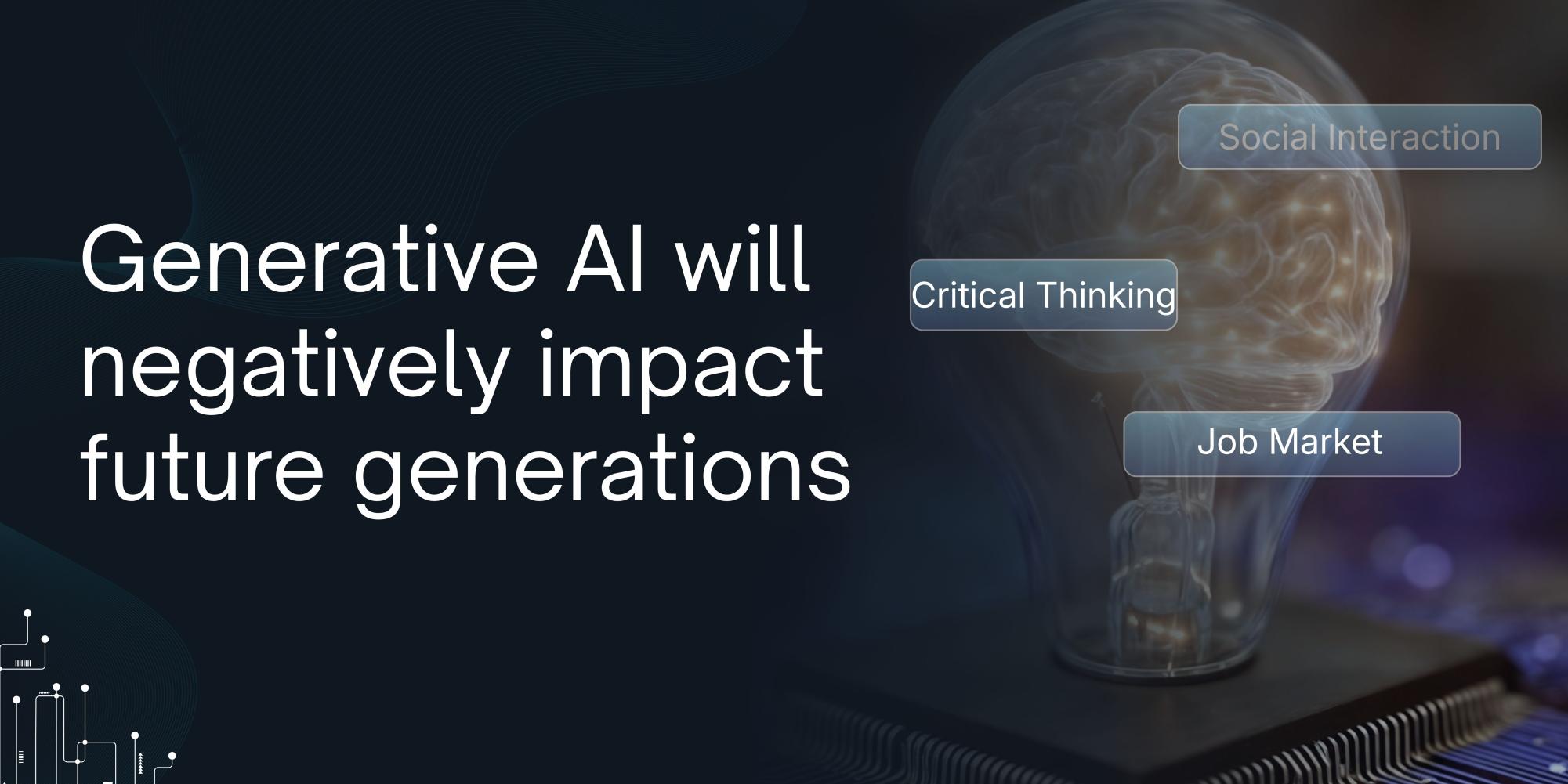

The use of Artificial Intelligence (AI) within the American education system has been the subject of much debate in recent years. To some, AI is a tool that can be used for students’ benefit, while to others, it is a cheat-system harmful to young minds. The latter is correct; generative AI will impact future generations’ ability to form critical thoughts and will decrease human skills such as social interaction and career creativity.
AI will decrease the critical thinking skills of students as they seek out generated responses. Recent generations such as Alpha and Beta are growing into a society where AI is being integrated into the education system, as a result, reducing their participation in reflective thinking.
According to Michael Gerlich, Head of Center for Strategic Corporate Foresight and Sustainability at SBS-Swiss Business School, AI tools may cause students to become “accustomed to the ease and convenience of … provided solutions” (Gerlich, Michael). Gerlich also detailed a study conducted by Liu, Frankel and Roohr, which concluded that younger participants showed higher dependence on AI tools and lower critical thinking compared to older participants.
Instead of communicating with peers, future generations will rely on AI for comfort and advice, decreasing their social connection. This is known as the ELIZA effect, where people begin to view AI as more human than it is.
According to a Princeton blog, “people form affective bonds with chatbots, self-disclose vulnerable thoughts, and attribute empathy and care to systems that are always available and nonjudgmental” (Center for Information Technology Policy). Human connection is also tied to improved mental and physical health, and as younger generations rely more on AI for companions, their overall health is at risk of deteriorating.
In the next five years, generation Alpha will begin to enter the workforce, but with AI in the picture, there is a significant threat to creative and STEM (Science, Technology, Engineering and Math) careers.
Nelson Granados, a Forbes contributor, wrote that “because GenAI allows creatives to work faster and better, the labor market for creativity and artistry is bound to shrink” (Granados, Nelson).
Unfortunately, AI’s ability to generate images resembling human art, as well as efficiently calculate data and statistics, are prompting companies to hire less workers and invest in AI.
Over the years, the integration of AI into the American education system has been debated and questioned. Some people claim it has the potential to benefit students by increasing efficiency, while others criticize its ability to generate answers.
Overall, with the rise of AI in modern society, future generations will be negatively impacted when it comes to critical thought, social interaction and creativity in the workplace.